
OKGames Baccarat Beginner Guide
Learn how Baccarat works before joining your first table. This beginner-friendly guide explains the basic rules, card values, Player and Banker hands, Tie results, third-card rules, and the complete flow of a standard Baccarat round.
Baccarat may appear formal at first, but the gameplay becomes easier to understand once you know how hand totals are calculated and how the main outcomes work. Use this guide to build a clear foundation before exploring different Baccarat formats.
Beginner-Friendly Rules
Card Values Explained
Player and Banker Basics
Responsible Gaming Tips
Baccarat compares two hands called Player and Banker. You do not control either hand or decide whether another card should be drawn because the game follows fixed drawing rules.

Everything Beginners Should Know Before Playing Baccarat
Baccarat is a comparing-card game built around two hands: Player and Banker. Before a round begins, participants choose which hand they believe will finish closest to nine or whether both hands will finish with the same value.
Unlike Blackjack, Baccarat does not require decisions such as Hit, Stand, Split, or Double Down. The dealing process follows established rules, allowing beginners to focus on card values, hand totals, available outcomes, and the final result.
Aim for a Total Near Nine
The hand finishing closest to a value of nine normally wins the completed round.
Understand the Player Hand
Player is one of the two main hands compared during every standard Baccarat round.
Understand the Banker Hand
Banker is the second hand and does not mean the participant becomes the dealer or the house.
Recognise a Tie Result
A Tie occurs when the Player and Banker hands finish with exactly the same final value.
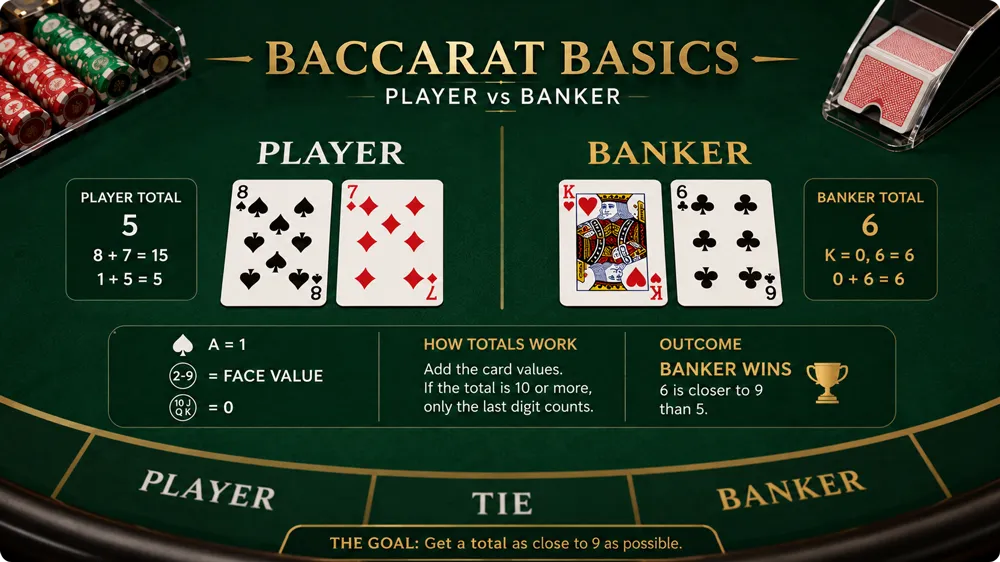
Learn the Card Values
Number cards keep their face value, Aces count as one, and tens, Jacks, Queens, and Kings count as zero when a Baccarat hand total is calculated.
Compare the Main Outcomes
Standard Baccarat tables normally present three primary outcomes: Player, Banker, and Tie. These are possible round results rather than individual people at the table.
Follow the Fixed Game Flow
The dealing process and third-card decisions are controlled by established Baccarat rules, so beginners do not need to make complicated card-playing decisions.
Baccarat Uses Only the Final Digit
When the combined card value reaches ten or more, only the final digit is counted. For example, seven plus eight equals fifteen, so the Baccarat hand value is five.
Essential Baccarat Terms Every Beginner Should Know
Learning the most common Baccarat terms makes it easier to read the table, understand each round, and follow how the final result is determined.
Player
Player is one of the two hands compared during a Baccarat round. It does not refer to the person taking part in the game.
Banker
Banker is the second hand used in the comparison. It is a game position and does not mean the participant becomes the dealer or the house.
Tie
A Tie occurs when the Player and Banker hands finish with exactly the same final value.
Natural
A Natural is an opening hand total of eight or nine. When a Natural appears, the round normally ends without another card being drawn.
Card Value
Aces count as one, number cards keep their face value, and tens, Jacks, Queens, and Kings count as zero.
Third Card Rule
The third-card rule determines whether the Player or Banker hand receives an additional card after the opening deal.
Hand Total
A Baccarat hand total uses only the final digit of the combined card value. For example, fifteen becomes five.
Winning Hand
The winning hand is the one that finishes closest to a value of nine after all required cards have been dealt.
Player and Banker Are Hand Names
The terms Player and Banker describe the two hands on the table. Choosing one of these outcomes does not mean you control the cards or act as the dealer.
How Baccarat Works Step by Step
Every Baccarat round follows the same structured sequence. Once you understand these six steps, it becomes much easier to follow the table and recognise how the final result is produced.
Choose an Outcome
Before any cards are dealt, decide which of the three main outcomes you wish to follow during the round.
- Player
- Banker
- Tie
Initial Cards Are Dealt
Two opening cards are normally dealt to both the Player hand and the Banker hand.
- Player receives two cards
- Banker receives two cards
- Opening totals are calculated
Third Card Rules Apply
If required, Baccarat automatically follows the official third-card drawing rules without any player decisions.
- Automatic procedure
- Official drawing rules
- No manual choice required
Compare Both Hands
The completed Player and Banker hand totals are compared to determine which one finishes closest to nine.
- Closest total wins
- Tie remains possible
- Results shown immediately
Review the Result
The completed round will finish as either Player, Banker, or Tie depending on the final hand totals.
- Player outcome
- Banker outcome
- Tie outcome
Prepare for the Next Round
Before continuing, review your remaining budget, session time, and personal limits to ensure you stay in control.
- Review your limits
- Take breaks when needed
- Continue responsibly
Baccarat Uses a Fixed Gameplay Sequence
Unlike some other table games, Baccarat follows a predefined dealing procedure. Beginners only need to understand the card values, hand totals, and official drawing rules to follow every round with confidence.
How to Choose Your First Baccarat Game
Baccarat tables may differ in speed, presentation, minimum limits, dealer format, and available features. Beginners should start with a clear table that makes the Player, Banker, and Tie outcomes easy to understand.
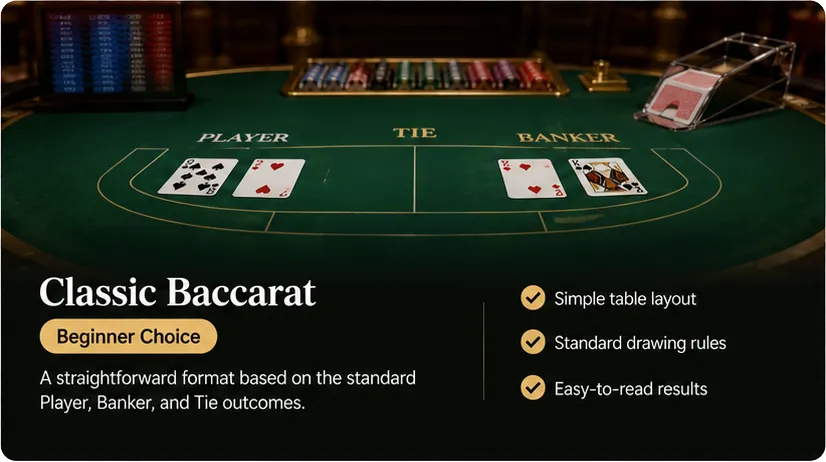
Classic Baccarat
A straightforward format based on the standard Player, Banker, and Tie outcomes.
- Simple table layout
- Standard drawing rules
- Easy-to-read results

Live Dealer Baccarat
A real-time Baccarat format hosted by a dealer with visible cards and live table action.
- Professional dealer
- Real-time card dealing
- Traditional table atmosphere
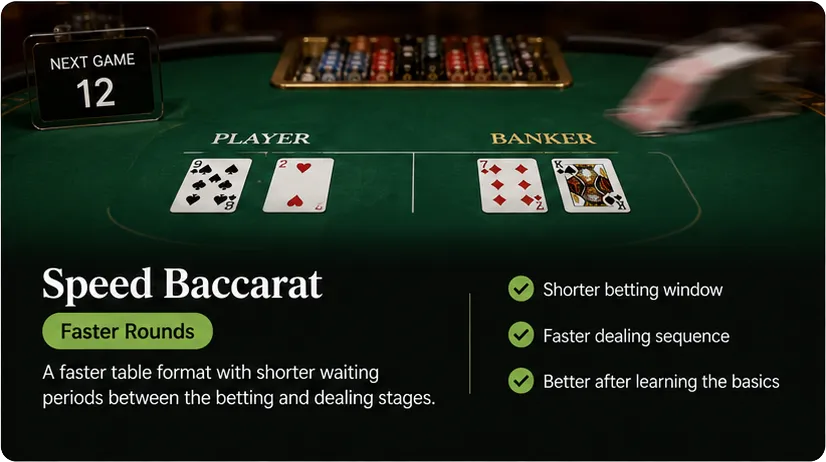
Speed Baccarat
A faster table format with shorter waiting periods between the betting and dealing stages.
- Shorter betting window
- Faster dealing sequence
- Better after learning the basics

Mobile Baccarat
A responsive version designed for smartphones and tablets with touch-friendly table controls.
- Responsive interface
- Touch-friendly controls
- Compact table display
Beginner Baccarat Selection Checklist
Review these points before choosing your first table. A clear and comfortable format is usually more useful than a table filled with advanced options.
Choose a table that clearly displays Player, Banker, and Tie.
Check that card values and final hand totals are easy to read.
Start with a standard-speed game while learning the round sequence.
Review the table limits before joining any game.
Avoid complex side options until you understand the main outcomes.
Use a mobile table with large controls when playing on a smaller screen.
Confirm that game rules and commission information are clearly available.
Set your entertainment budget and session time before starting.
Start With a Simple, Standard-Speed Table
Classic Baccarat is usually easier for beginners because it gives you more time to read the table, review the hand totals, and understand the result before the next round begins.
How Baccarat Card Values Are Calculated
Baccarat uses a simple card-value system. Once you understand the value assigned to each card and how totals above nine are reduced, you can quickly read both hands during every round.
Ace Cards
Every Ace has a Baccarat value of one, regardless of its suit.
Number Cards
Cards from two through nine keep the same value shown on their face.
Tens and Face Cards
Tens, Jacks, Queens, and Kings all have a Baccarat value of zero.
Two Plus Five
A two and a five produce a combined Baccarat hand value of seven.
- Card one: 2
- Card two: 5
- Final total: 7
Seven Plus Eight
Seven plus eight equals fifteen, but Baccarat uses only the final digit, producing a hand value of five.
- Card one: 7
- Card two: 8
- Final total: 5
King Plus Nine
A King counts as zero, so a King and a nine produce a final Baccarat hand value of nine.
- King value: 0
- Number card: 9
- Final total: 9
Six Plus Six
Six plus six equals twelve. Only the final digit is used, so the hand value becomes two.
- Card one: 6
- Card two: 6
- Final total: 2
Ace Plus Queen
An Ace counts as one and a Queen counts as zero, giving the completed hand a value of one.
- Ace value: 1
- Queen value: 0
- Final total: 1
Four Plus Five
Four and five produce a total of nine, which is the highest possible Baccarat hand value.
- Card one: 4
- Card two: 5
- Final total: 9
Nine Is the Highest Baccarat Hand Value
Baccarat hand totals never remain above nine. Whenever the combined card value reaches ten or more, the first digit is removed and only the final digit counts.
How Player and Banker Drawing Rules Work
Participants do not decide whether either Baccarat hand receives another card. The game automatically applies fixed drawing rules after the opening Player and Banker totals are calculated.
Check for a Natural
The opening totals are reviewed immediately after the first two cards have been dealt to each hand.
- Natural 8 or 9
- Round normally stops
- No third card is required
Player Total of 0 to 5
When the Player hand begins with a total from zero through five, it normally receives a third card.
- Player draws automatically
- No participant decision
- Banker rule follows next
Player Total of 6 or 7
When the Player hand begins with six or seven, the hand stands and does not receive another card.
- Player stands
- No extra card
- Banker total is reviewed
Banker Draws on 0 to 2
The Banker hand normally draws another card when its opening total is zero, one, or two.
- Automatic Banker draw
- Applies without manual input
- Final total calculated afterward
Banker Total of 3 to 6
For these totals, the Banker decision depends on whether the Player drew a third card and the value of that card.
- Conditional drawing rule
- Player third card matters
- Handled automatically by the game
Banker Stands on 7
A Banker opening total of seven stands. Opening totals of eight or nine are already treated as Natural hands.
- Banker stands on 7
- Natural on 8 or 9
- Round moves to comparison
Player Rule
The Player hand normally draws on zero through five and stands on six or seven.
Banker Rule
The Banker drawing rule may depend on its own total and the value of the Player hand’s third card.
Natural Rule
An opening total of eight or nine is a Natural and normally ends the drawing stage immediately.
You Do Not Need to Memorise Every Banker Combination
Baccarat tables apply the third-card rules automatically. Beginners should understand the general flow, but they do not need to calculate or select the drawing action during live gameplay.
Practical Baccarat Tips for New Players
Baccarat does not require complicated card decisions, but a clear approach can still help beginners understand the table, manage each session, and avoid unnecessary confusion.
Learn the Main Outcomes First
Focus on understanding Player, Banker, and Tie before exploring additional table options.
- Recognise all three outcomes
- Understand that they are hand names
- Read the result after each round
Start With Standard Baccarat
A classic table usually provides more time to review the cards, totals, and final result.
- Avoid fast tables at first
- Choose a clear interface
- Follow the round sequence carefully
Check the Table Rules
Review the available limits, payout information, commission details, and table format before joining.
- Read the minimum and maximum limits
- Check Banker commission information
- Review the game instructions
Use Consistent Session Limits
Decide how much time and money you are comfortable using before the session starts.
- Set a fixed entertainment budget
- Choose a session time limit
- Stop when either limit is reached
Ignore Previous Round Patterns
Roadmaps and result histories display earlier outcomes, but they cannot guarantee what will happen next.
- Each new round is independent
- Past streaks do not ensure future results
- Avoid chasing visible patterns
Take Regular Breaks
Short breaks can help you review your budget, session time, and overall comfort level.
- Pause after several rounds
- Check your remaining budget
- Leave when the session stops being enjoyable
Keep It Simple
Learn the standard game before trying faster tables, alternative formats, or additional side options.
Follow Your Limits
A fixed budget and session duration are more useful than reacting emotionally to individual round results.
Treat Every Round Separately
Previous Player, Banker, or Tie results do not determine the outcome of the next completed round.
Understanding the Table Is More Important Than Playing Fast
Beginners should choose a pace that allows enough time to review the card values, hand totals, table rules, and final result without feeling pressured.
Common Baccarat Mistakes Beginners Should Avoid
Many early mistakes happen because new players misunderstand the hand names, move too quickly, follow previous results, or begin without clear personal limits.
Confusing Player With the Participant
Player is the name of one Baccarat hand and does not mean that the person at the table controls those cards.
- Player is a hand position
- Banker is also a hand position
- Neither hand is manually controlled
Adding Card Totals Incorrectly
Some beginners forget that Baccarat keeps only the final digit when the combined value reaches ten or more.
- Ten becomes zero
- Fifteen becomes five
- Nineteen becomes nine
Trying to Control the Third Card
Baccarat does not allow participants to choose whether the Player or Banker hand receives an additional card.
- Drawing rules are fixed
- The process is automatic
- No Hit or Stand decision is needed
Chasing Previous Outcomes
A sequence of Player or Banker results does not guarantee that the same outcome will continue.
- Histories show past results only
- Streaks can end at any time
- Patterns cannot ensure a result
Choosing a Table Too Quickly
Joining without reviewing the speed, limits, rules, and interface can create unnecessary pressure.
- Check table limits first
- Choose a suitable pace
- Review all displayed information
Continuing Beyond Personal Limits
Extending a session to recover earlier losses can lead to rushed and emotional decisions.
- Do not increase limits impulsively
- Never chase losses
- Stop according to the original plan
Quick Mistake-Prevention Checklist
Use this checklist before beginning a Baccarat session and review it again whenever you take a break.
I understand that Player and Banker are hand names.
I know how Baccarat card values and totals are calculated.
I have reviewed the table limits and game rules.
I have selected a table speed that feels comfortable.
I will not treat previous results as guaranteed patterns.
I have set a fixed entertainment budget.
I have set a clear session time limit.
I will stop instead of trying to recover a loss.
Previous Results Cannot Predict the Next Hand
Baccarat scoreboards and roadmaps organise completed results, but they should not be treated as systems that guarantee the next Player, Banker, or Tie outcome.
How to Keep Baccarat Safe and Responsible
Baccarat should remain a form of adult entertainment. Personal limits, regular breaks, realistic expectations, and early warning signs can help you maintain control.
Set a Budget
Use only money reserved for entertainment and never use essential funds for Baccarat.
Limit Session Time
Decide when the session will end before starting and take regular breaks away from the screen.
Never Chase Losses
Accept the result of each session and avoid increasing your activity to recover money already lost.
Play Only When Comfortable
Avoid joining a Baccarat table when you feel stressed, tired, upset, or under pressure.
- Choose a calm environment
- Avoid emotional decisions
- Stop when concentration drops
Separate Gaming From Income
Baccarat is not a reliable way to earn money or solve financial problems.
- Treat it as entertainment
- Do not expect guaranteed returns
- Never borrow money to continue
Use Available Control Tools
Account tools may help you control deposits, activity, session length, or temporary access.
- Deposit limits
- Session reminders
- Cooling-off or exclusion tools
Recognise Warning Signs
Repeatedly exceeding limits or hiding your activity may indicate that it is time to stop and seek support.
- Spending more than planned
- Ignoring work or family duties
- Feeling unable to stop
Keep Regular Breaks
Step away from the table regularly to review your mood, remaining budget, and session duration.
- Leave the screen temporarily
- Check the time
- Reassess whether to continue
Ask for Help Early
Speak with a trusted person or professional support service when gaming begins to affect your finances or wellbeing.
- Do not hide the problem
- Use support resources
- Consider self-exclusion
Responsible Baccarat Session Checklist
A responsible session should remain affordable, controlled, transparent, and easy to stop.
I am of legal age and permitted to participate.
My entertainment budget does not include essential funds.
I have decided when this session will end.
I understand that outcomes cannot be guaranteed.
I will not borrow money or chase losses.
I will take regular breaks during the session.
I know where to find account control tools.
I will stop and seek help if gaming causes harm.
Baccarat Is for Adults and Entertainment Only
Never treat Baccarat as a source of income. Stop immediately when you reach your personal limit or when the activity begins to affect your finances, responsibilities, mood, or relationships.